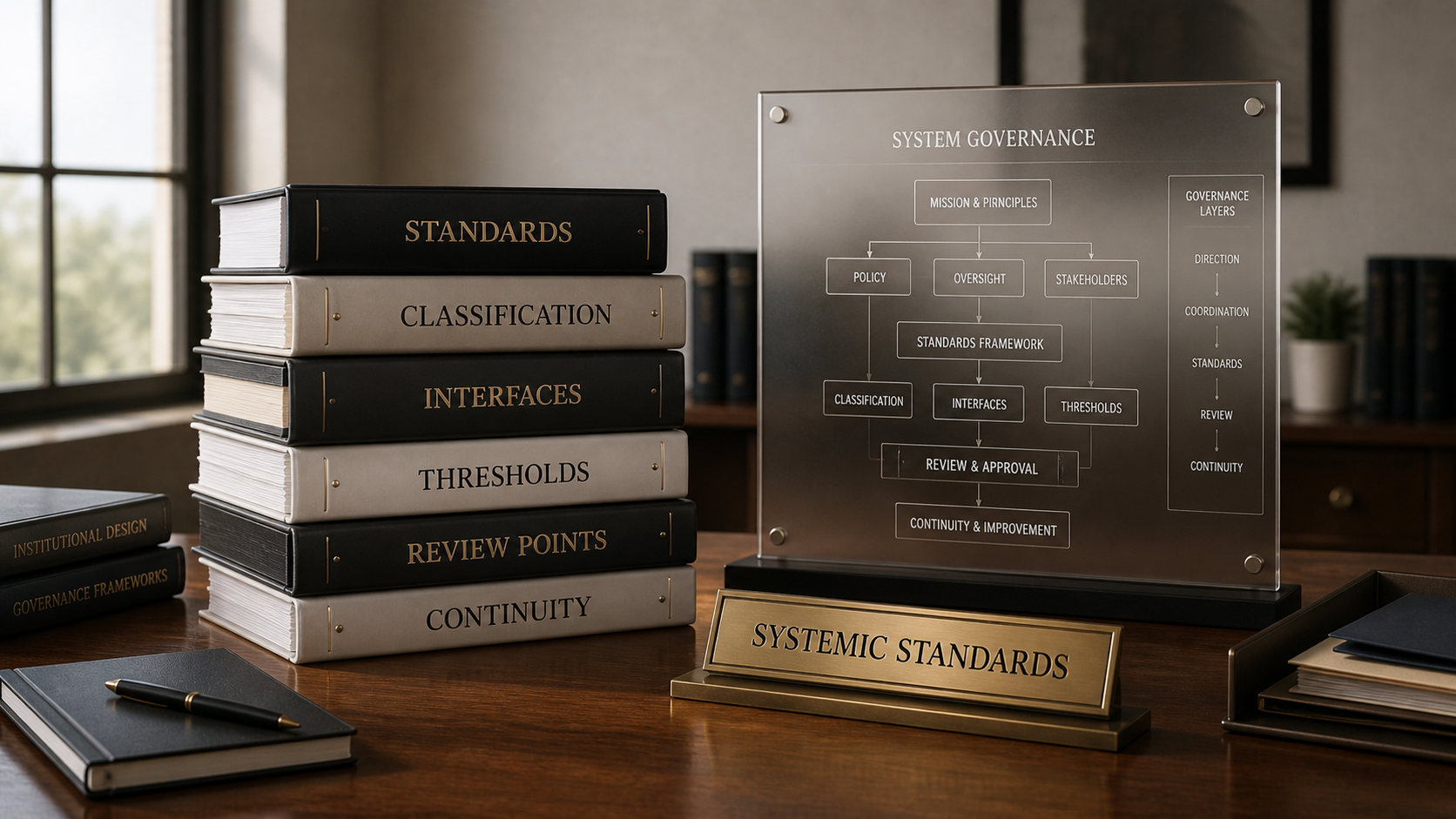
Standards bring continuity to impact initiatives by channeling individual intent into shared rules, disciplined execution, and clear direction. In doing so, they convert collective momentum into durable change.
At the immediate level, this allows initiatives to hold course through leadership turnover and funding shifts.
At a deeper level, when standards operate within a self-governing framework that directs their evolution, continuity no longer depends on individual stewardship. The system sustains itself across successive cycles of change.
Once individual intentions and aspirations that would otherwise pull in different directions are aligned through shared values and constrained by a governing system, lack of coordination gives way to inevitable outcomes.
What this enables:
Let’s consider a small onshore wind farm with approximately 12 turbines.
The Circular Wind Foundations (TG-2015) initiative illustrates the difference systemic standards make. UGC-0000706006 – Wind Energy Decommissioning & Materials Recovery sets out end-of-life treatment of turbine foundations: full removal at the developer’s cost or retention in the ground. It determines whether turbine foundations are fully removed at end-of-life, at the developer’s cost, or remain in the ground, including more than 25,000 tonnes of steel and concrete.
Systemic standards have been successfully applied across a range of sectors, from logistics to aerospace. One area that has received far less attention is their application in system governance, where they can serve as a tool for guiding, structuring, anchoring, and adjudicating governance processes across complex institutional settings.
Continuity rarely comes from alignment or sustained attention. It emerges from operating conditions that remain stable across fragmented institutions, shifting mandates, and leadership turnover. Where systems endure, it is because authority, interfaces, timing, and review were structured in advance and allowed to function with minimal renegotiation. Used well, systemic standards remain the most effective tool for this task.
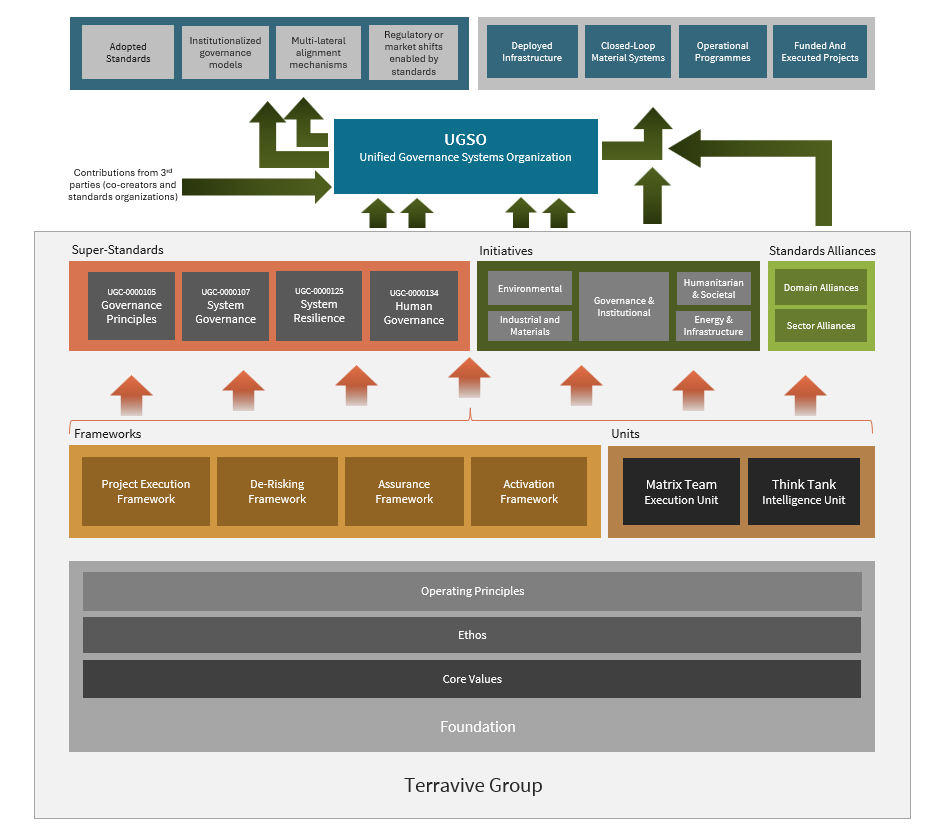
The following diagram shows how systemic standards convert activity into persistence. Initiatives and programmes deliver immediate impact, but without standards, what is learned remains tied to individual projects.
Systemic standards capture, stabilize, and transfer governance logic, operating models, and assurance requirements so they can be reused, adopted, and aligned across initiatives, institutions, and domains. In this way, impact does not reset with each project, partner, or funding cycle, but accumulates through shared structures that outlast individual executions.
For readers who want to explore how systemic standards are structured, governed, and anchored, further material is maintained by UGSO:

128 City Road
London EC1V 2NX
United Kingdom
Copyright © Terravive Group 2025. All Rights Reserved.
Companies House reg. no 16233378