
About This Article
Systemic standards define the rules, interfaces, and repeatable steps that allow different actors, organizations, and system components to work together predictably toward shared outcomes.
This article examines how systemic standards work, where they work, where they fail, and some of the other continuity-critical environments in which they may also prove useful.
Introduction
Breakdowns in execution rarely begin where they become visible. They emerge earlier, when interfaces are left vague and sequencing weakens. By the time consequences surface, they are already a fact.
Politics, culture, leadership turnover, and weak coordination are real factors, but they usually operate downstream of deeper operating conditions. Where roles are unclear, incentives reset between cycles, handovers remain ambiguous, and review arrives too late, systems lose coherence long before failure is formally recognized.
Political turnover can intensify the problem, but it is not the root cause. The deeper issue is that decisions often move through environments where authority shifts, memory dissipates, and consequences mature after the people responsible have moved on.
The following diagram shows this internal logic more directly.
.
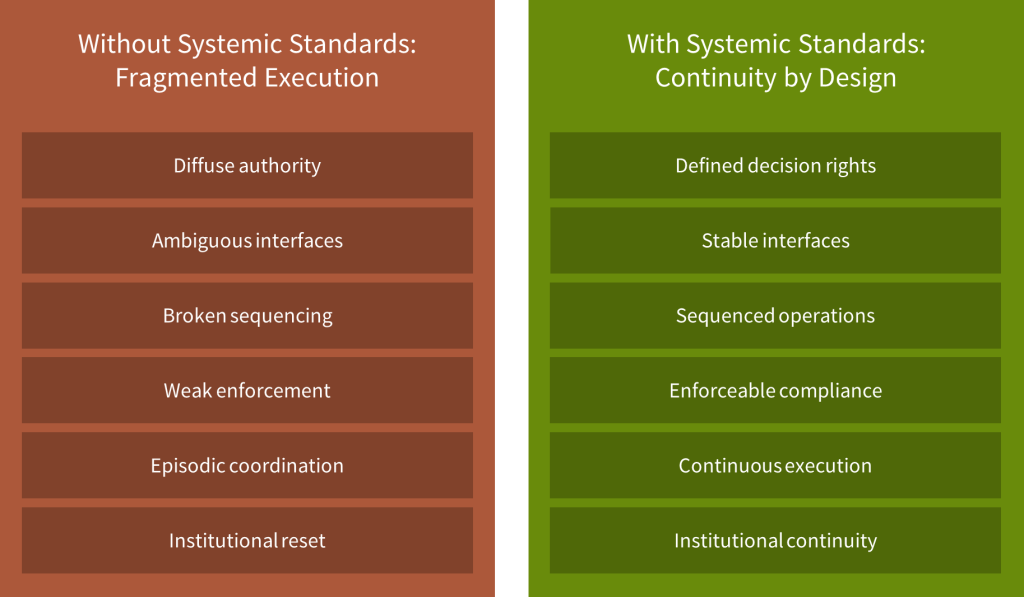
Figure 1 – How systemic standards change the operating conditions of execution
Why Continuity Breaks Down
Continuity breaks down through gradual loss of coherence. Decisions are taken within diffuse authority structures, consequences surface long after attention has moved on, and responsibility disperses across institutional layers until it is no longer traceable.
In such conditions, execution depends on personalities rather than operating logic, and systems drift toward short horizons and lowest-resistance outcomes regardless of stated intent.
What appears as fragmentation is often entirely predictable. The standards were never there: no one specified where authority ends, no one connected the responsibilities, no one asked whether compliance would survive a change of cycle.
Decision quality degrades, accountability weakens, and errors repeat because the system never fully absorbs them.
The absence of such processes results in the following:
- Authority diffuses: Decisions scatter across overlapping mandates with no clear locus of responsibility.
- Responsibilities disconnect: Tasks separate from consequences and ownership becomes unclear.
- Timing fragments: Actions fall out of sequence and coordination breaks down.
- Compliance degrades: Rules weaken in practice as enforcement loses continuity.
What Systemic Standards Do
Systemic standards stabilize how decisions move through a system. They stabilize pathways of action before pressure arrives, define roles, fix interfaces, sequence timing, and anchor enforcement so that authority, responsibility, and action remain coherent across organizational boundaries and operating cycles.
Well-defined standards remove reliance on the right person being in the room and prevent the system from losing its place when leadership changes. Operationally, they translate intent into repeatable behaviour. Decisions become traceable, incentives align with outcomes, handovers become predictable, and learning accumulates instead of dissipating.
Operational Mechanics
Systemic standards hold continuity in place by structuring how action unfolds within and between organizations. In practice, this rests on defined decision rights, stable interfaces between actors, operational milestones and deadlines, and compliance loops that detect and correct deviations early.
Combined, these mechanisms reduce variance where discretion would otherwise fragment outcomes.
The second diagram shifts the focus from external operating structure to internal continuity logic. It shows how systemic standards stabilize the chain from interpretation to decision, from decision to execution, and from execution to institutional memory. Where that chain holds, continuity no longer depends on repeated correction at each stage.
.

Figure 2 – How systemic standards turn structured intent into durable execution
Where They Work
Systemic standards tend to hold where continuity is non-negotiable and variance is costly. In such environments, operating conditions are stabilized in advance and allowed to run with minimal renegotiation.
The following domains show how systemic standards can sustain multi-decade continuity.
Large-Scale Logistics Networks
In international transport and logistics, fixed interfaces, handling protocols, and rules governing the timing and order of handovers allow cargo to move predictably between operators, systems, and jurisdictions.
The ISO container standard fixed dimensions, interfaces, and handling protocols across ships, rail, and trucks. That single move eliminated incompatibility at transfer points and allowed cargo to move seamlessly across jurisdictions, companies, and decades. Global trade scaled not because coordination improved, but because the operating logic no longer had to be renegotiated at every handover.
Result: continuity emerges from standardization that becomes invisible once established.
Aviation Operational Controls
Commercial aviation runs on tightly standardized phraseology, checklists, routing rules, and incident protocols enforced across airlines and jurisdictions. Crews who have never worked together operate safely under pressure because authority, sequencing, and escalation are pre-defined.
Result: safety persists across turnover, geography, and scale.
Financial Clearing Systems
Settlement rules, cut-off times, and reconciliation procedures keep transactions coherent across institutions and time zones. Predefined message standards (such as the SWIFT protocol), netting protocols, and exception workflows reduce ambiguity, limit counterparty exposure, and ensure that breaks are surfaced and resolved before positions roll forward.
Oversight is embedded through continuous matching, end-of-day controls, and auditable records, allowing high-volume flows to clear with predictable finality despite scale, turnover, and geographic dispersion.
Result: reliability holds across turnover, geography, and scale because execution runs on fixed conditions.
Where They Fail
Systemic standards break down where authority is diffuse, enforcement is inconsistent, and exceptions become routine. In such settings, standards exist on paper but not in practice: mandates overlap, decision rights blur, and compliance depends on discretion rather than design. Over time, workarounds accumulate, interfaces loosen, and timing disciplines erode until continuity gives way to episodic coordination.
Political and institutional cycles accelerate the drift. Priorities reset, incentives detach from outcomes, and accountability weakens as consequences surface after decision-makers leave office. Without stable review triggers and enforceable links between decisions and downstream consequences, errors persist and compound.
What follows is gradual loss of coherence, as systems revert to negotiation, short-horizon fixes, and incentive-driven behaviour in place of durable operating logic.
Other Continuity-Critical Environments
Similar conditions appear well beyond aviation, finance, and logistics, especially in systems exposed to fragmented authority, long timelines, and uneven coordination. Large public programmes, cross-border infrastructure delivery, disaster response systems, and long-horizon resource management all face recurring discontinuities arising from dispersed mandates, asynchronous cycles, and weak learning loops.
The following examples illustrate how similar operating conditions appear across diverse domains:
- Large multi-actor institutional systems
- National infrastructure programmes spanning multiple agencies and funding cycles
- Cross-border energy interconnection and grid coordination regimes
- Multi-agency disaster response command systems
- River-basin and transboundary water management authorities
- Large-scale public health coordination frameworks
In such settings, systemic standards function in the same way: by fixing decision rights, stabilizing interfaces, sequencing operational and reporting cycles, and embedding review triggers across institutional boundaries.
Conclusion
As the examples of logistics, aviation, and financial clearing show, systemic standards sustain coherence by fixing decision pathways, interfaces, sequencing, and enforcement in advance.
Where they function well, continuity is no longer dependent on personalities, goodwill, or repeated coordination. It becomes embedded in the operating conditions of the system itself.
