The Circular System Governance Initiative (CSGI) provides an applied environment for improving how institutions carry out governance within institutions and in real-world contexts. It addresses the practical breakdowns that arise when mandates are fragmented, responsibility is spread across multiple actors, and representation is incomplete. In doing so, it helps institutions sustain coordination over longer horizons despite organizational boundaries.
At the core of the CSGI framework (CSGF) is a different diagnosis. Governance failure is not explained only by bad actors, weak leadership, or conflicting interests. It also emerges because institutions must act on simplified representations of reality, interpret normative values under ambiguity, and sustain judgement within fragmented structures and changing cycles.
The initiative operates through four connected layers:
Decision Infrastructure: The framework provides an operating environment through which matters are formed into decisions, assessed against standards, assigned, documented, and followed up
Systemic Standards: System governance standards structure the handling of normative values, provide a basis on which admissibility is established, and help preserve rationale throughout governance processes.
Enforcement: UGA standards are enforced as active governance rules, and adherence is checked at defined review points and recorded in the institutional record to preserve traceability and transparency.
Capability Development: Capability Development Programmes develop the institutional competence and practitioner readiness needed for coherent and value-aligned decision-making.
Standards activity focuses on structuring governing documents that strengthen judgement, accountability, documentation, coordination, and the link between capital and execution. These standards are developed through engagement with real-world contexts where friction and breakdowns in governance can be observed directly, and are continuously refined within a structured decision and review environment.
Beyond improving consistency and compliance, the aim is to create a workable basis for assessing cases so that coherence can be maintained from one case to the next and from one institutional setting or operating cycle to another.
The CSGF Academy delivers capability development programmes designed to strengthen institutional competence and ensure coherent decision-making under shared responsibility and over longer horizons. The goal is to provide a stronger institutional basis where conventional arrangements struggle to preserve integrity and maintain adherence to governing documents and established values.
Its content is built around the capabilities identified as necessary for governance systems to function coherently: decision integrity, coordination continuity, incentive coherence, accountability resolution, and adaptive learning.
In practice, this means better mandate handling, clearer decision records, stronger coordination, structured review mechanisms, and formal correction procedures. This helps institutions correct drift without losing continuity through leadership and organizational change.

Overview materials, architecture notes, and supporting documentation are available upon request.
The UGC (Unified Governance Continuum) is the ecosystem through which governance standards are developed, issued, and advanced toward multilateral adoption, and within which TG initiatives are conceived, assured, and deployed. UGA standards function as active constraints – defining, for example, what decisions are admissible and how voting is conducted.
Keeps decisions aligned with standards, rules, institutional purpose, and prior decisions across cases
Tests decisions against explicit criteria before they are formalized or allowed to proceed
Links scenario, case formation, adjudication, formal decision, and institutional record
The CSGF Plenum application sits at the heart of the decision infrastructure layer. It provides a structured basis on which decisions can be formed, reviewed, and retained within institutional processes.
In practice, this gives decisions a stable basis as they move between people, departments, and operating cycles. The aim is to reduce the common institutional failure mode in which a decision is taken, but the basis for it becomes fragmented, unreviewable, or lost.
A further institutional failure arises when issues that clearly require a decision are raised but never converted into one. They remain noted, discussed, or deferred, and the result is drift through inaction. CSGF Plenum addresses this by allowing qualified actors to elevate issues into a formal decision process. Under defined conditions, the system itself can also elevate issues and trigger the creation of formal decisions.
The infrastructure creates the conditions for AI-assisted governance enforcement. The purpose of this enforcement layer is not to replace institutional judgement. It operates against the standards framework by identifying deviations, surfacing weaknesses, and supporting review of whether decision processes remain aligned with the governing rules and constraints in force.
Within the broader architecture, this creates a closed institutional loop. Standards shape decision conditions. Capability development strengthens the competence required to apply them. Decision infrastructure supports coherent execution and preserves rationale. Governance stewardship can then identify recurring weaknesses and feed those back into standards development and amendment.
That loop is central to the initiative. It supports a more durable system in which standards, institutional competence, decision infrastructure, and enforcement reinforce one another, while weaknesses can be identified and addressed through structured amendment.
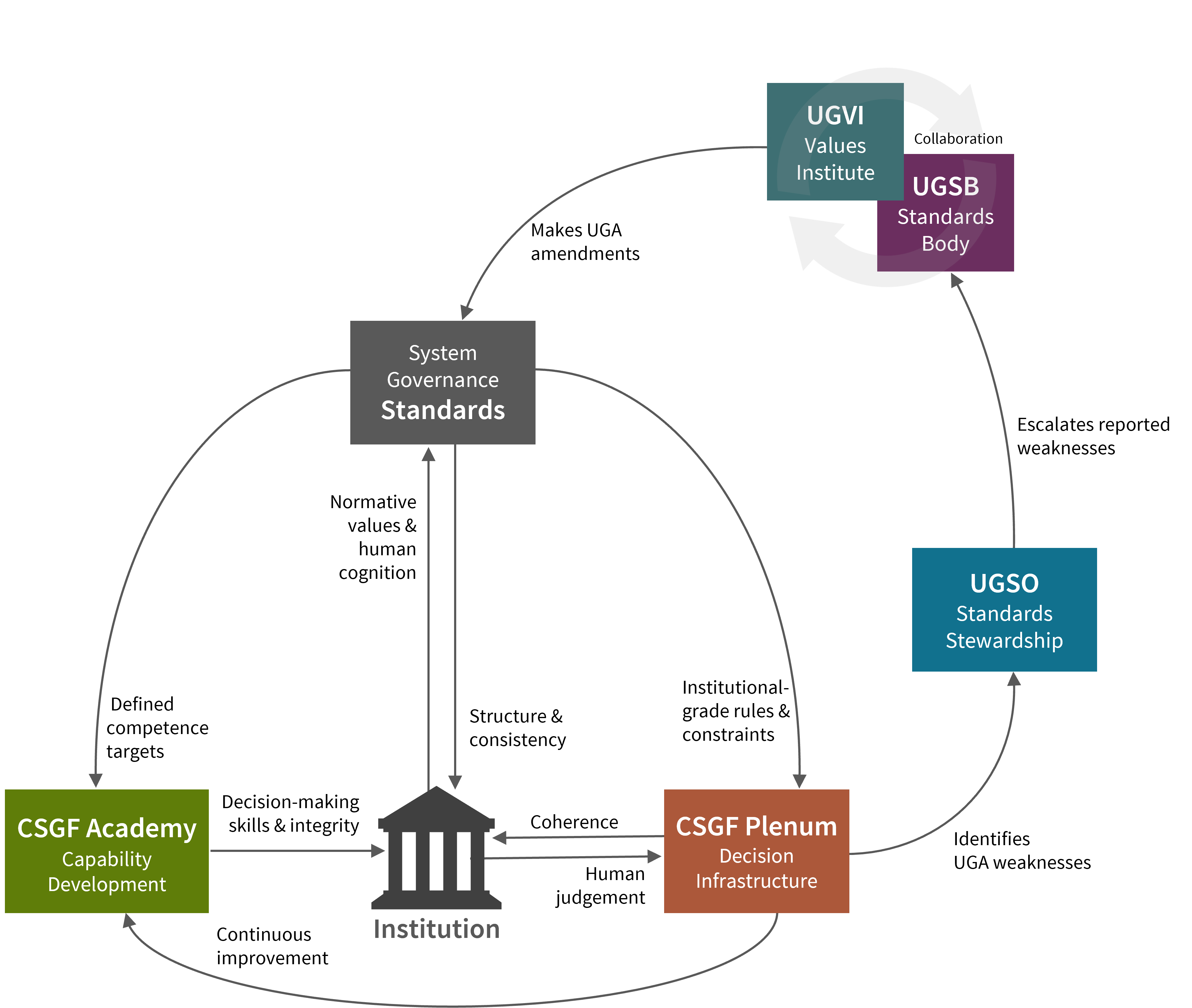

This diagram shows how governance outcomes improve when standards, capability development, and decision infrastructure reinforce one another.
Standards define what must hold. Capability Development Programmes prepare institutions to work to that standard. CSGF Plenum applies those standards in decision and review, preserving adherence and rationale in the institutional record. This makes weaknesses easier to detect and correction easier to carry through.
CSGF Plenum improves decisions once they are being made. But it also strengthens the point before that: identifying when a matter has become decision-relevant and ensuring it is brought into a formal decision pathway.
In complex institutions, many consequential matters are not rejected, approved, or resolved. They are simply left unformed. No clear owner is assigned, no formal decision is made, no accountable record is created, and no one is held responsible for the omission. The cost of making a decision may be modest, but the hidden cost of leaving that decision unmade can be severe.
CSGF Plenum is positioned exactly where many institutional failures remain hidden: before a matter becomes a formal decision, but after its consequences are already visible. This is where difficult questions are often left unnamed, unassigned, and unresolved. By sitting at the intersection of standards, legislation, institutional values, live cases, and the decision record, CSGF Plenum can surface these consequential matters and convert them into structured decision processes.
It does not decide on behalf of the institution. It helps ensure that consequential matters are recognized, framed, and brought to a formal verdict instead of remaining informal, unresolved, or invisible.
Decision infrastructure also creates a feedback loop between institutional execution and the rules that shape it. When decisions are formed, assessed, recorded, and followed up in a structured environment, the system can begin to detect recurring friction between legislation, standards, institutional values, and practical outcomes.
Many legal and procedural weaknesses are not visible as single failures. They become visible as patterns: repeated delays, inconsistent outcomes, unclear authority, excessive procedural burden, unresolved value conflicts, or decisions that produce consequences misaligned with the institution’s stated purpose.
CSGI can use this accumulated decision record to identify where legislation or regulation may require review. The system can highlight where legal rules are producing unintended effects, where institutional mandates conflict, where bureaucratic requirements create avoidable cost, and where existing law no longer supports fair, coherent, or efficient outcomes.
Because the system preserves structured decision records, recurring failures can be converted into amendment-ready evidence much faster than in conventional review processes. CSGF can help identify which rule is creating friction, what outcomes it is producing, which values or standards are being compromised, and what legislative or regulatory changes could address the issue.
This can significantly accelerate the preparation of legislative amendments, regulatory updates, and policy corrections. Reform options can be generated, documented, and compared, while legal authority remains with the competent public institutions.
In mature deployments, this feedback loop could also change how legislative and regulatory updates are initiated and prepared. Instead of relying mainly on periodic reviews, political pressure, or fragmented institutional reports, public bodies could work from structured evidence generated through the decision infrastructure itself. This would make the path from observed institutional failure to proposed legal correction faster, clearer, and more accountable.
This gives CSGI a longer-range institutional learning function: decisions do not only produce outcomes; they also generate evidence about the adequacy of the rules under which society is operating.
The initiative is grounded in UGA standard families whose constraints materially shape design viability, including UGA-0000107 (System Governance), UGA-0000503 (Decision Integrity), UGA-0000251 (Accountability & Feedback), and UGA-0000521 (Governance Competence).
These standards shape governance design from the outset, helping keep interpretation, judgement, accountability logic, and institutional capability aligned across organizational cycles.
In practice, the combined standard set defines what must hold for admissibility, mandate handling, decision records, coordination, and the preservation of rationale. This helps prevent a common failure mode in which decisions are made, but the basis for them becomes fragmented, difficult to review, or institutionally lost.
The UGA standards are intended for advancement toward multilateral adoption through demonstrated real-world performance. The CSGF framework contributes to this by generating auditable process data, including decision records, adherence metrics, and rationale documentation.
The articles below explore structural aspects of governance relevant to this initiative, including cognitive limits, representational constraints, interpretive divergence, and the role systemic standards can play in preserving coherence across governance processes.

128 City Road
London EC1V 2NX
United Kingdom
Copyright © Terravive Group 2026. All Rights Reserved.
Companies House reg. no 16233378