
The Impact Exchange is designed to provide a structured participation environment for impact initiatives, analogous to the role of rating agencies, investment banks, and exchanges in traditional capital markets.
Impact initiatives often reach a point where further progress depends less on internal development and more on coherent engagement from external actors. Capital providers, strategic partners, technical experts, certification bodies, and delivery channels all need visibility into structure, accountability, and readiness before meaningful participation can begin.
The Impact Exchange is designed to support this requirement. It helps translate initiatives from internally structured constructs into opportunities that external actors can evaluate, align with, and engage through a shared participation context.
Rather than functioning as a marketplace or brokerage mechanism, the Impact Exchange is designed as a structured participation environment that supports continuity, comparability, and alignment across initiatives and lifecycle stages. This allows engagement to take place on the basis of structured understanding rather than bespoke interpretation.
Participation becomes viable when initiatives are presented in a form that clarifies governance structure, capital sequencing, accountability boundaries, and execution status.
The Impact Exchange is designed to clarify and structure these entry conditions so capital can assess participation within a more comparable framework.
In fragmented environments, participation often depends on bilateral negotiation, bespoke due diligence, and informal trust networks. Each initiative must establish legitimacy on a largely case-by-case basis.
Within the Impact Exchange, participation is intended to take place within a defined architecture. Governance structure, stage readiness, liability boundaries, and capital sequencing are made visible before negotiation begins. This is designed to shift participation from relationship-dependent engagement toward a more framework-based approach.

Beyond matching capital to initiatives, the Impact Exchange is designed to establish the structural conditions under which participation in impact initiatives can begin to take on asset-class characteristics
When a fully structured offshore wind decommissioning initiative is presented through the Impact Exchange, capital providers can review governance architecture, certification status, capital commitments, liability boundaries, and stage readiness within a more comparable framework. What might otherwise require extended bilateral diligence can instead be assessed within a defined participation structure.
This is designed to reduce structural friction, clarify participation thresholds, and support more repeatable allocation logic. In that way, credible impact can begin to take on institutionally allocatable form.
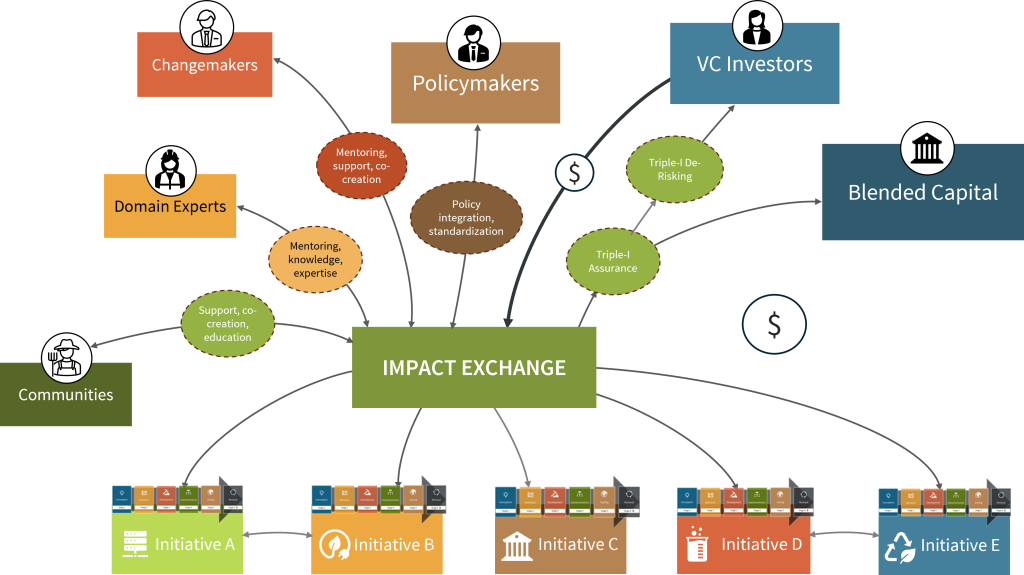
This diagram shows how the Impact Exchange conditions initiatives for institutional participation by aligning governance structure, capital entry points, assurance logic, and execution readiness within a single framework.
Transforms initiatives into institution-readable constructs through governance structuring, lifecycle articulation, and exposure of dependencies, enabling external actors to assess participation without interpretive ambiguity.
Supports engagement by sequencing participation pathways, clarifying risk boundaries, and aligning deployment with execution realities and mandate compatibility.
Maintains governance persistence and obligation traceability as initiatives evolve, ensuring coordination stability across lifecycle transitions.
Applies structured human–AI reasoning environments to strengthen analytical discipline, challenge assumptions, and scale decision support across initiatives.
In spirit, the Impact Exchange performs a role comparable to early capital-market infrastructure. Where exchanges and rating agencies enabled participation within established markets, the Impact Exchange contributes to the conditions under which structured impact participation can emerge.
This includes supporting:
Asset definition
Governance legitimacy
Readiness signalling
Continuity of coordination
The intent is not to replicate market mechanisms, but to operate upstream of them – shaping the participation environment before formal market structures form.

128 City Road
London EC1V 2NX
United Kingdom
Copyright © Terravive Group 2026. All Rights Reserved.
Companies House reg. no 16233378