Initiative Lifecycle

Every initiative advances through a fixed execution model that reflects how projects behave under real delivery pressure. The six stages define what must exist at each step, from first signal through renewal, so initiatives can absorb capital, reduce uncertainty, and transfer responsibility without losing continuity.

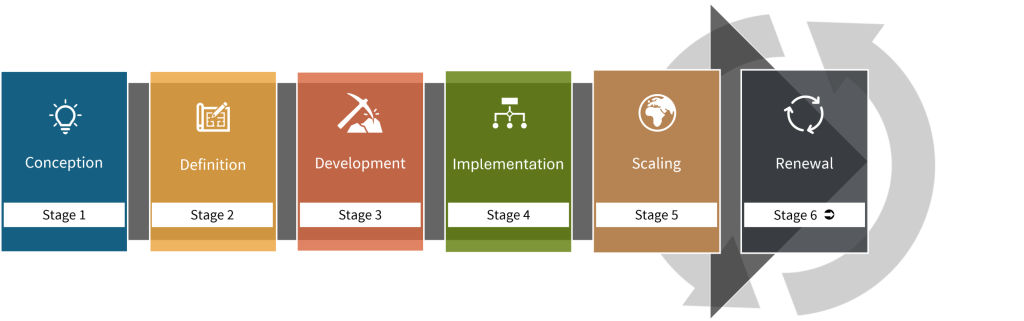
The lifecycle diagram illustrates how risk and capital exposure are structured across the initiative stages. Early stages concentrate uncertainty and are financed through venture-style capital under strict validation and stop criteria. As initiatives progress and uncertainty is reduced, risk transitions toward actors structurally mandated to carry long-horizon exposure, enabling recovery at the handover point while preserving continuity through scaling and renewal.

Stage Model

  • Stage 1: Conception → The opportunity is real, bounded, and worth formal definition.
  • Stage 2: Definition → Scope, constraints, and success criteria are locked before resources expand.
  • Stage 3: Development → Technical and operational substance is built to a testable, investable form.
  • Stage 4: Implementation → The initiative enters real-world deployment with accountable execution controls.
  • Stage 5: Scaling → Adoption broadens through replication, capital transition, and institutional uptake.
  • Stage 6: Renewal → The initiative is sustained, upgraded, or restructured based on evidence over time.

Framework Links

  • Investment sequencing is handled explicitly through the De-Risking Framework, including where venture-style capital typically applies and where blended or institutional capital becomes structurally appropriate as uncertainty falls.
  • Assurance is handled through the Assurance Framework, defining what evidence and verification must exist at each stage. See: Assurance Framework.
  • Adoption and real-world uptake are handled through the Activation Framework, ensuring delivery becomes institutionalised deployment rather than a completed build. See: Activation Framework.