
The De-Risking Framework sets out how early-stage impact initiatives can be structured into diligence-ready opportunities for blended and institutional capital.
It is a stage-gated lifecycle and funding architecture designed to protect venture investors, trigger repayment of principal plus agreed margin at the first blended-capital drawdown, and transfer long-horizon execution risk to actors mandated to carry systemic risk.
By embedding assurance gates, a defined recovery trigger, and disciplined capital handover, the framework is intended to help convert fragile concepts into diligence-ready opportunities that can scale without weakening governance or mission integrity.
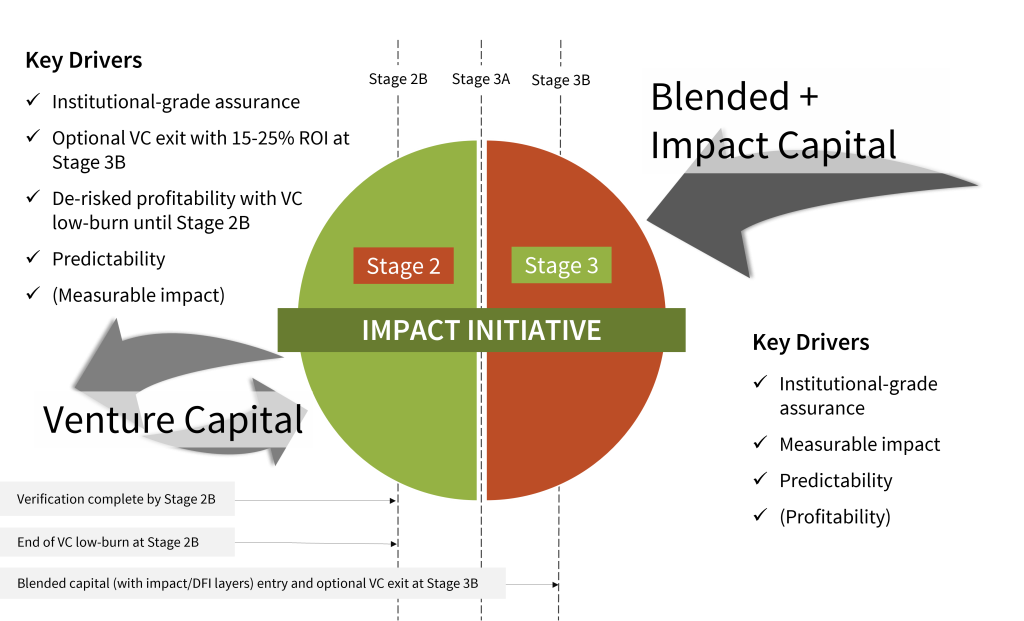
The De-Risking Framework is designed to move initiatives from concept to scalable deployment under controlled risk. It incorporates independent assurance gates, repayment of principal plus agreed margin at the first blended-capital drawdown, and a structured handover of long-term execution risk to blended and institutional capital providers mandated to carry it.
The result is a repeatable investment arc in which early catalytic capital accelerates validated projects, exits through a defined recovery mechanism, and is then recycled into the next initiative, while blended and impact capital support scaling and renewal.
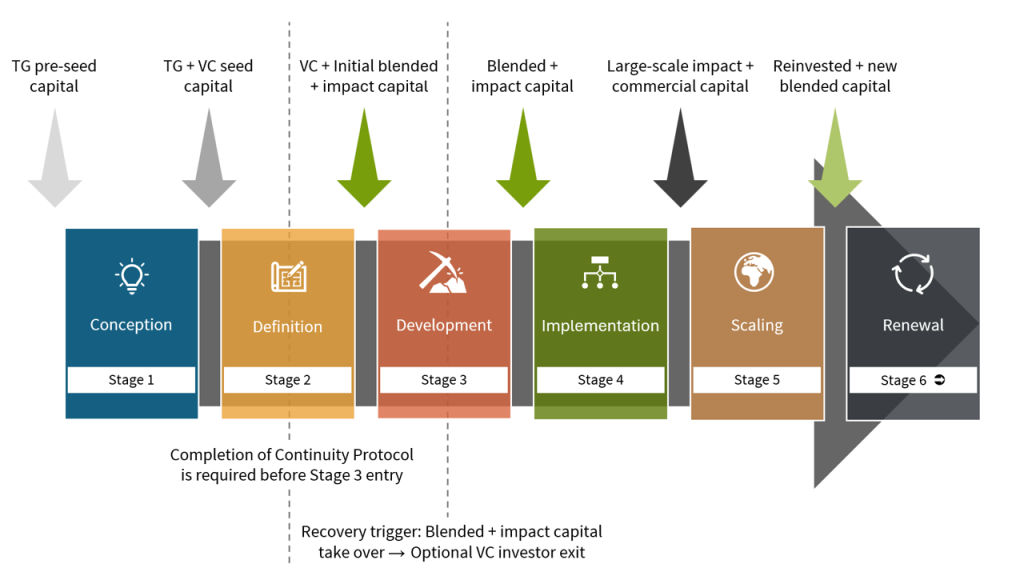
This lifecycle diagram shows how risk and capital exposure are structured across the stages of an initiative. Early stages carry the highest uncertainty and are financed through venture-style capital under stage-gated advancement and independent assurance validation. As initiatives progress and uncertainty is reduced, execution risk is transferred at the Stage 3 handover point to blended and impact capital providers, enabling capital recovery while preserving continuity through scaling and renewal.
The framework is structured around staged validation and capital sequencing. Early venture funding is applied only until defined assurance thresholds are met. At the first blended-capital drawdown, repayment of principal plus agreed margin is triggered, with Stage 4 continuing under blended and impact financing. Blended-capital drawdown at Stage 3 is contingent on prior adoption of lifecycle planning, reporting cadence, and participation protocols defined under the Activation Framework. This structure is designed to protect early investors, preserve continuity of execution, and reduce the risk of collapse in the transition from early innovation to real-world delivery.
The De-Risking Framework is designed to make early-stage exposure rational for venture investors while preserving the pathway to scale. Venture capital funds staged validation where uncertainty is highest and speed matters most. Blended and institutional capital assumes the longer-duration deployment phase once assurance thresholds are met, because those actors are structurally mandated to carry continuity risk. This sequencing turns systemic impact execution into a financeable lifecycle rather than an open-ended gamble.

128 City Road
London EC1V 2NX
United Kingdom
Copyright © Terravive Group 2026. All Rights Reserved.
Companies House reg. no 16233378