
The 3-Gap Lens is a structural diagnosis tool for understanding why otherwise viable regenerative and circular initiatives fail to reach scale. It identifies three reinforcing failure modes – Capital, Alignment, and Continuity – that repeatedly block execution, erode confidence, and collapse long-horizon outcomes.
The lens is not descriptive; it is diagnostic, showing where intervention is required before capital, coordination, or continuity can be expected to hold.
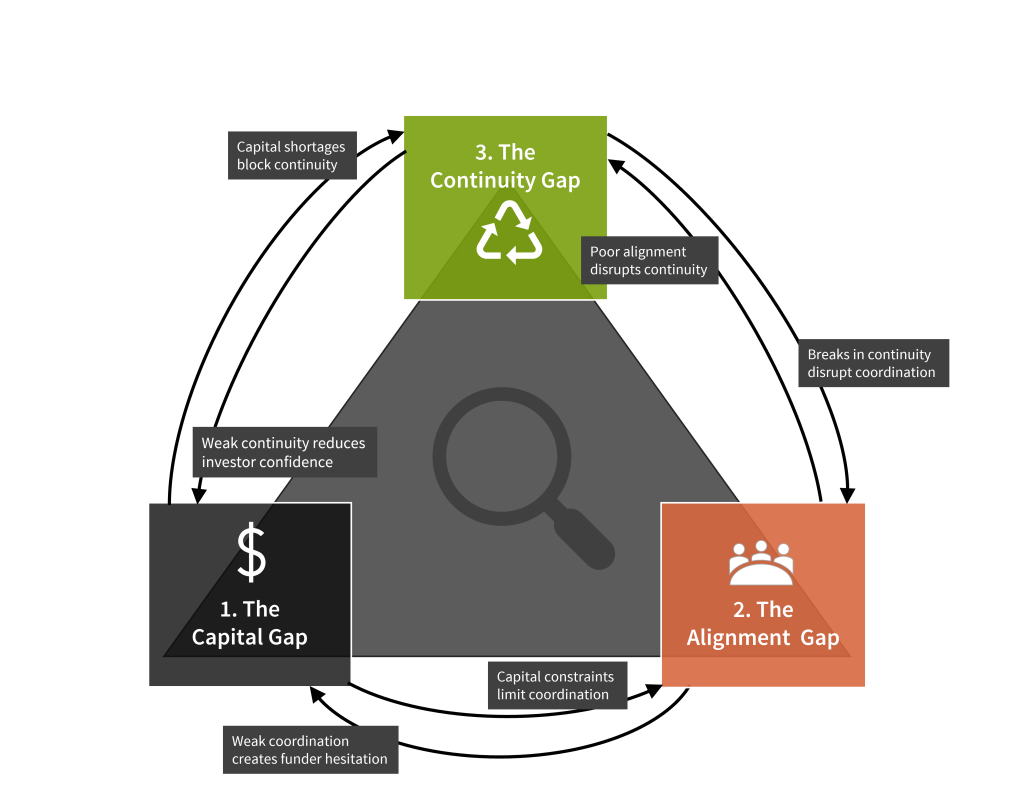
The three gaps do not operate independently. Weak capital structures limit coordination, misalignment disrupts continuity, and broken continuity feeds back into investor hesitation. The result is a negative feedback loop in which each unresolved gap amplifies the others, making late-stage fixes ineffective. The 3-Gap Lens makes these interactions explicit so structural remedies can be applied at the correct leverage points rather than after failure has already set in.
The Capital Gap describes the structural mismatch between long-horizon regenerative initiatives and short-cycle financial systems. Projects stall not because capital is unavailable, but because prevailing funding models are structured around compressed timelines, narrow risk interpretations, and linear return expectations that cannot recognise system-level or lifecycle value. Initiatives that require stability, predictability, and extended performance horizons therefore fall outside standard investment logic.
This mismatch produces hesitation, stop–start execution, and underinvestment in initiatives that are otherwise technically and economically viable. Funding exists, but cannot be deployed coherently when lifecycle boundaries are unclear, uncertainty is structurally penalised, or value accrues beyond conventional reporting windows. Bridging the Capital Gap requires capital structures that tolerate temporal depth, acknowledge non-linear value creation, and align deployment logic with system durability rather than transactional throughput.
The Alignment Gap arises when actors operate without a shared structural frame. Effective regeneration depends on multiple participants working within consistent definitions, responsibilities, and timelines. In practice, initiatives fragment because standards, governance expectations, and operational interpretations vary across institutions, contractors, regulators, and investors.
Knowledge becomes siloed, coordination remains ad hoc, and each phase of execution must be renegotiated from scratch. Even when funding is secured, inconsistency in terminology, accountability boundaries, and handover protocols generates friction, cost escalation, and decision latency. Without alignment, execution slows, accountability diffuses, and otherwise viable initiatives struggle to scale because the system cannot act as a coherent whole. Closing the Alignment Gap requires shared frameworks that anchor interpretation, enable coordination, and maintain structural consistency across organisational boundaries.
The Continuity Gap reflects the systemic inability to sustain performance over long time horizons. Regeneration depends on consistent behaviour across decades, yet most delivery systems are structured for short-term throughput. Responsibilities dissolve at transition points, monitoring weakens after commissioning, and maintenance becomes discretionary rather than structurally embedded.
When continuity breaks, operational performance declines, ecological gains reverse, and confidence in outcomes erodes. Funding cycles interrupt oversight, knowledge transfer degrades, and lifecycle accountability fragments, pulling systems back toward extractive patterns despite initial success. Addressing the Continuity Gap requires institutional mechanisms that preserve responsibility, maintain observability, and ensure behavioural consistency beyond project delivery, embedding durability as an operational condition rather than an aspirational outcome.

128 City Road
London EC1V 2NX
United Kingdom
Copyright © Terravive Group 2025. All Rights Reserved.
Companies House reg. no 16233378