
About This Article
This article builds on Systemic Standards in Real-World Systems and the Root Causes of Governance Failure series. It examines the role systemic standards can play in system governance under conditions of complexity, institutional fragmentation, and limited human cognitive bandwidth. It shows that their importance goes far beyond consistency, compliance, and coordination, extending into the interpretation of values, the structuring of judgement, the preservation of rationale, and the maintenance of coherence across governance processes.
Introduction
Modern governance depends on translation. Broad mandates, legal requirements, policy objectives, institutional responsibilities, operational constraints, and real-world conditions must be turned into decisions and actions. This translation is rarely straightforward. Meaning is compressed. Context is lost. Responsibilities are divided. Review arrives late or unevenly.
The breakdown often begins in this movement from intent to execution. A mandate may be clear at the level of purpose but weak at the level of application. Different actors may classify the same situation differently, apply different thresholds, record different forms of rationale, or treat continuity as a matter of individual memory rather than institutional structure.
Systemic standards matter because they strengthen this movement. They provide a structured basis for classification, interpretation, sequencing, review, documentation, and continuity. They do not make governance simple. They make the operating conditions of governance less dependent on improvisation, personality, memory, and fragmented institutional practice.
From Institutional Intent to Durable Execution
Shared values do not apply themselves. The distance between a normative commitment and an institutional decision is where governance most commonly loses coherence.
.

Figure 1 – How systemic standards turn institutional intent into durable execution
.
Figure 1 shows the route from institutional intent to durable execution. Values and mandates do not become coherent decisions on their own. They must pass through interpretation, criteria formation, trade-off assessment, decision recording, review, and correction.
This is where system governance often starts to fail. Interpretation varies. Trade-offs are handled differently from case to case. Rationale is lost. Accountability thins across institutional boundaries. Decisions accumulate without a coherent basis that can be reviewed, challenged, or refined.
Systemic standards can strengthen this route. They can define how normative values are translated into admissible criteria, how decisions are evaluated, what thresholds apply, what must be recorded, and how institutional memory is preserved. They do not remove politics, disagreement, or judgement. They make the path from value to decision more structured and traceable.
Figure 2 shows the failure pattern in traditional governance environments. Authority diffuses, interfaces remain unclear, sequencing breaks down, enforcement weakens, coordination becomes episodic, and continuity is repeatedly lost across institutional cycles. Systemic standards change those operating conditions. They define decision rights, stabilize interfaces, sequence operations, strengthen compliance, support continuous execution, and preserve institutional continuity beyond the individuals temporarily inside the system.
.
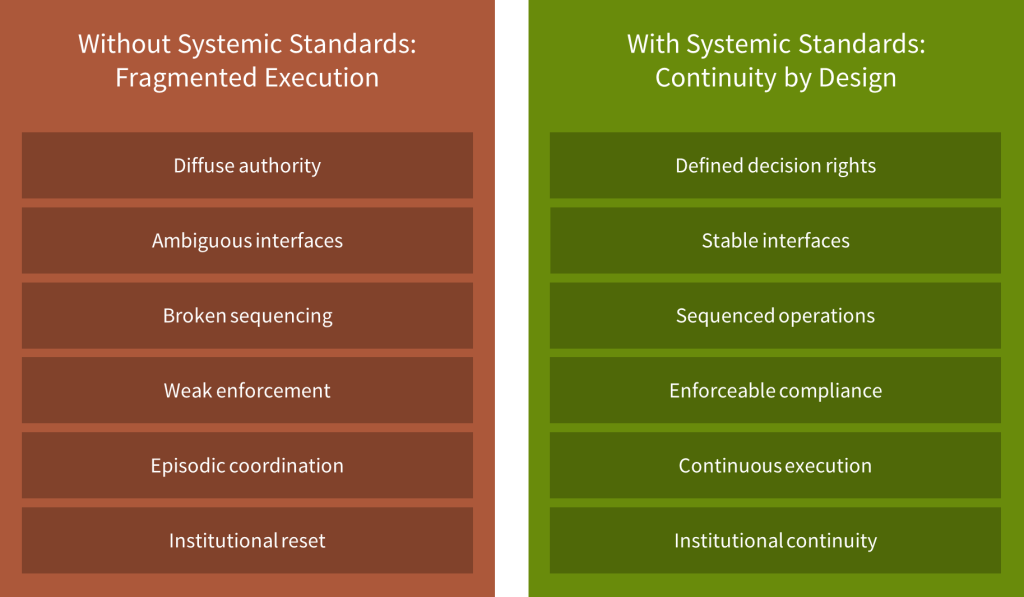
Figure 2 – How systemic standards change the operating conditions of execution.
.
The Role Systemic Standards Can Play
Systemic standards are often misunderstood as static rulebooks or compliance artefacts. Used properly, they do much more than that. They function as behavioural constraints, adjudicative structure, and a means of providing continuity within governance itself.
They can define normative baselines. They can clarify what counts as a relevant consideration and what does not. They can specify what information is required before a situation can be treated as a real case. And they can structure how competing claims are weighed. Furthermore, they formally define what forms of review are required, and what must be preserved as part of the decision record.
This is important because governance does not act on reality directly. It acts through categories, definitions, documents, procedures, and institutional interpretation. Without standards strong enough to structure that movement, too much depends on who is involved, what they notice, what they remember, and which pressures dominate at the time. A decision that cannot be traced cannot be meaningfully governed.
What Makes This Role Decisive
What makes this role decisive is not disagreement alone, but the scale and complexity under which governance now has to operate. The complexity of the world has long outgrown the cognitive bandwidth of unaided human governance, and the complexity is still growing at an accelerating pace. More institutions are involved. More variables interact. More consequences emerge later and elsewhere. And more decisions must be made under conditions that no single mind, committee, or agency can fully track.
This is why governance so often falls back on simplification, fragmentation, and retrospective correction. Human cognition compresses. Institutions divide labour. Accountability disperses. Review becomes partial. The system keeps moving, but its coherence weakens.
Our tendency is to add more human checkpoints as a compensation mechanism. But this does not solve the problem. Instead, it usually produces delay, inconsistency, and decision fatigue.
This is not just an administrative problem. It is the structure itself that is too weak. Governance needs stronger operating structure at the points where complexity turns into drift: interpretation, adjudication, formalization, review, and record. This is where systemic standards matter most. They do not make complexity disappear. They make it harder for consequential judgement to slide into unstable discretion. Standards define the operating logic. They establish the categories, thresholds, review points, records, and admissible forms of reasoning. But once the volume of cases, actors, dependencies, and consequences becomes too large, the standards themselves need decision infrastructure capable of applying them with consistency.
Collective Hybrid Intelligence
For the purposes of this article, C/H/I refers to Collective Hybrid Intelligence: human cognition, artificial intelligence, and other forms of machine intelligence combined within a system to form the machinery needed once human cognition can no longer scale on its own.
The first role of C/H/I is connective. It can help surface patterns, dependencies, contradictions, and prior-case parallels that human actors will often miss or only partially see. That does not remove judgement, but it reduces blind spots at the point where judgement is exercised.
Its second role is enforcement. Standards only matter if they are applied. C/H/I can help enforce formal rule sets with a level of consistency and coverage that human institutions struggle to maintain on their own. It can track whether required conditions were met, whether escalation thresholds were triggered, whether rationale was recorded, and whether decisions remained within defined bounds.
Its third role is procedural. Collective decision processes often degrade because context is lost, rationale fragments, and no durable chain connects discussion, judgement, and outcome. C/H/I can help manage that chain. It can preserve context, maintain traceability, support structured adjudication, and strengthen institutional memory across personnel changes and operating cycles.
That shifts oversight onto firmer ground. It no longer depends only on whether someone happened to be watching. It becomes more evidentiary. The system can retain visible links between standards, adjudication, formal decision, and record. It does not remove human responsibility. It makes it traceable.
Conclusion
Systemic standards have a larger role in system governance than process improvement or administrative consistency. Their strongest function is to strengthen the operating structure through which complex mandates become coordinated action.
They do this by defining classifications, interfaces, thresholds, sequencing, review points, documentation requirements, and continuity mechanisms. In fragmented institutional environments, these elements matter because governance often fails in the movement from intent to execution. Meaning is compressed, responsibility is divided, records become uneven, and continuity depends too heavily on the individuals currently inside the system.
Under those conditions, systemic standards provide a more durable execution layer. They make decisions easier to trace, processes easier to review, responsibilities easier to locate, and institutional learning easier to preserve across cycles.
C/H/I becomes relevant because human cognition alone cannot reliably manage the volume of dependencies, records, exceptions, and cross-institutional interactions involved. Used properly, it can help apply standards consistently, surface inconsistencies, preserve context, and strengthen the link between mandate, process, decision, and record.
Without that machinery, system governance remains too dependent on personal judgement, institutional memory, improvisation, and late correction.
If you are interested in applied work in this area, see the Circular System Governance Initiative.
