
About This Article
This is Article 2 in The Missing Normative Layer series. It examines artificial gestation as a case study in institutional decision-making under conditions of competing mandates, fragmented incentives, and unresolved value conflict. Article 1 in the series introduced and framed the problem – the missing normative layer. Article 3 in the series addresses the structural implication: how normative values and constraints must be operationalized within reasoning processes to support coherent adjudication.
The Research Context
Over recent years, scientific research on extrauterine gestation, including experimental work on partial ectogenesis, has advanced from speculative concept to experimental reality. One of the clearest examples is the work carried out at the Children’s Hospital of Philadelphia, where extremely premature lambs were sustained in fluid-filled artificial support systems intended to simulate key conditions of the uterine environment. The stated motivation behind this line of research has been neonatal medicine, particularly the improvement of survival prospects for extremely premature infants. Yet the significance of the research does not end with its clinical rationale. It also brings into view a broader stakeholder field, shaped by different motives, mandates, and value commitments.
Artificial gestation research does not move forward under a single purpose or a single institutional logic. Around the clinical rationale sits a wider constellation of actors, each approaching the field through its own incentives and priorities: researchers pursuing scientific advancement, commercial actors pursuing platform and patent position, investors pursuing frontier opportunity, regulators and public institutions responding to risk and legitimacy concerns, and wider publics reacting through moral, cultural, and political frames.
The research therefore becomes more than a medical development. It becomes a live example of how a technically coherent line of work can unfold within a fragmented field of motives.
A Multi-Actor Landscape
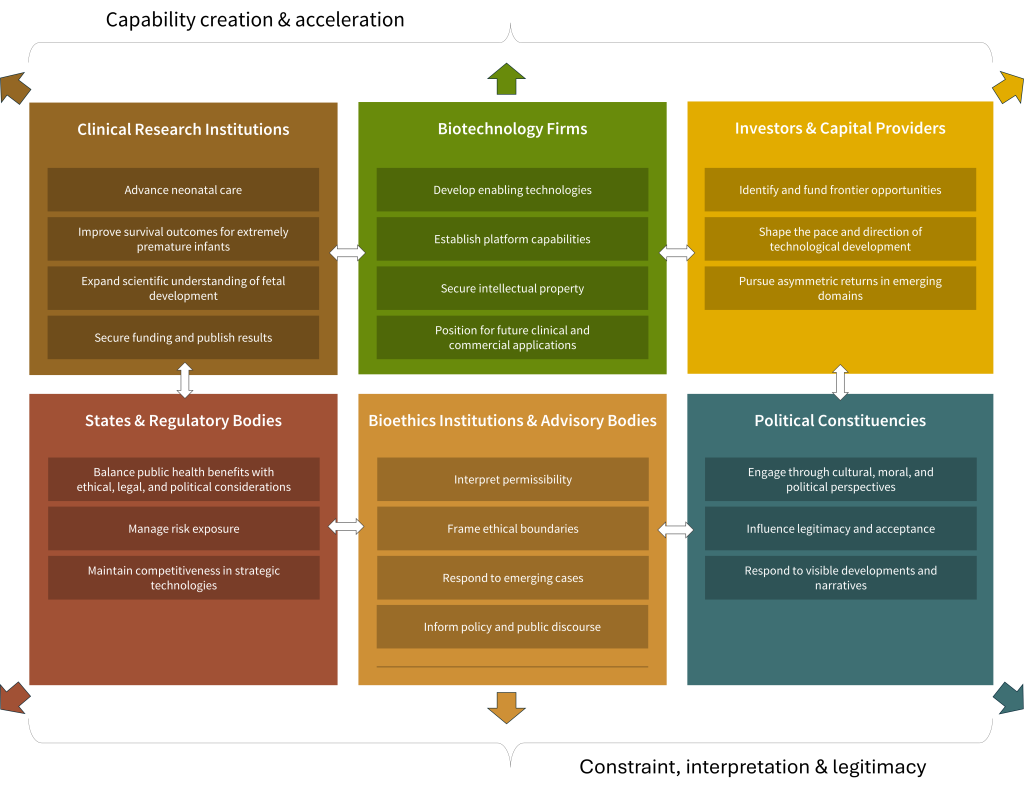
Artificial gestation research unfolds within a multi-actor environment in which each stakeholder operates under its own mandate, incentives, and value commitments. The resulting dynamic is not coordinated by design, but emerges from the interaction of six principal actors:
Stakeholder Interaction – Dynamics
The diagram does not show six isolated stakeholder groups. It shows six actors operating under distinct normative value structures and distinct adjudication logics, even where some values overlap or partially align. What matters is not only whether they care about similar things in the abstract, but how those values are ranked, interpreted, and resolved in practice. The system emerges from that interaction.
- Clinical Research Institutions ↔ Biotechnology Firms: Scientific work does not remain abstract. It is continuously translated into technical capabilities, prototypes, and platforms. At the same time, the direction of research is influenced by what biotechnology firms consider viable to develop, fund, and scale, creating a feedback loop between discovery and application.
- Biotechnology Firms ↔ Investors & Capital Providers: Technological capability alone does not determine direction. Capital introduces acceleration, selection, and timing. Investors decide which pathways are funded, which are delayed, and which are abandoned, thereby shaping not only what becomes possible, but what becomes prioritized.
- Investors & Capital Providers ↔ Political Constituencies: Capital allocation does not remain invisible. Funding decisions influence which developments reach public awareness and at what speed. In turn, public perception, cultural framing, and political sensitivity affect the acceptability of investment strategies, especially in ethically charged domains.
- Political Constituencies ↔ Bioethics Institutions & Advisory Bodies: Public reaction does not automatically translate into structured ethical reasoning. Bioethics institutions interpret, formalize, and stabilize these reactions into articulated positions, frameworks, and recommendations that can be engaged with at a policy level.
- Bioethics Institutions & Advisory Bodies ↔ States & Regulatory Bodies: Ethical interpretation alone has no direct effect unless it is translated into enforceable boundaries. States and regulators absorb ethical guidance, but must reconcile it with legal structures, geopolitical considerations, and strategic interests, often resulting in partial or context-dependent implementation.
- States & Regulatory Bodies ↔ Clinical Research Institutions: Regulation does not simply constrain research; it reshapes it. Clinical pathways, permissible experimentation, and funding structures are all influenced by regulatory decisions, which in turn are informed by both ethical interpretation and public pressure.
Each of these actors behaves rationally within their own frame. The system that emerges from their interaction, however, does not necessarily produce a shared direction or a clearly defined end state.ally within its own mandate. Taken together, their incentives do not converge toward a clearly articulated end state.
Momentum Without Convergence
What emerges from these interactions is not a coordinated direction, but an aggregate movement produced by multiple actors pursuing different objectives within their own institutional frames. The research advances, the surrounding system responds, and the cycle continues. Yet no shared logic exists for defining a common end state or reconciling competing priorities across the whole field.
The Institutional Observation
Artificial gestation research presents a clear case of unresolved normative conflict. It reveals a stakeholder field in which multiple rational actors advance the same line of research under different motives, mandates, and value commitments. Clinical, commercial, financial, political, ethical, and societal logics all participate in shaping the trajectory, yet none of them defines a shared objective for the field as a whole.
The result is not disorder, but indeterminacy. The research advances, institutions respond, and the system evolves through continuous interaction. Yet when priorities collide, no common logic exists for determining which considerations should prevail, how trade-offs should be resolved, or how a coherent direction should be established.
The dilemma is this: in domains of this kind, it is not enough to identify stakeholders, articulate values, or establish constraints. Conflict must also be resolved in a consistent and justifiable manner. Without such a capability, progress continues, but direction remains contingent on the interplay of competing forces rather than on deliberate reasoning.
This is Article 2 in The Missing Normative Layer series. Article 3 in the series addresses the structural implication: how normative values and constraints can be operationalized within reasoning processes to support coherent adjudication.
